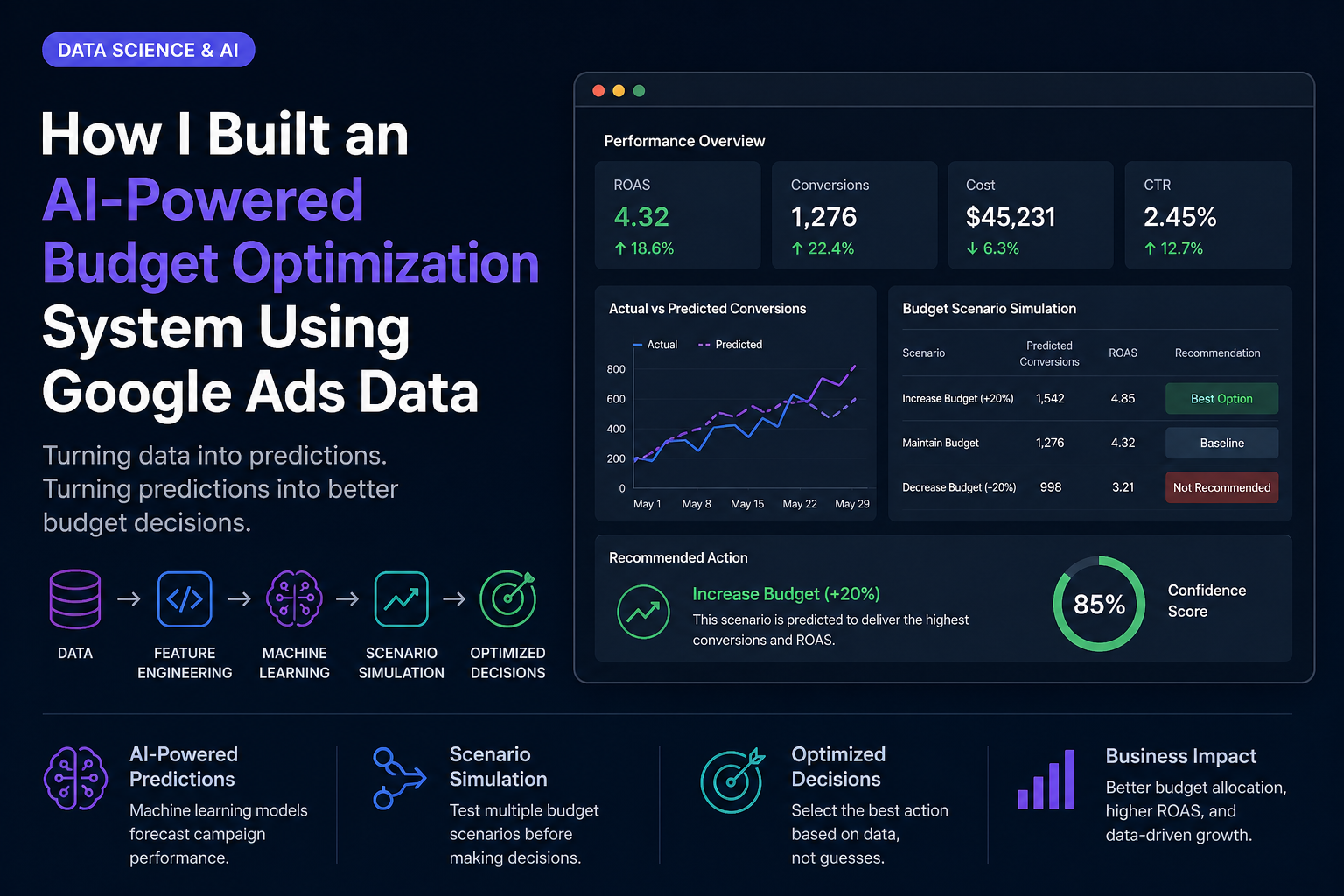
How I built a data-driven system to predict performance and optimize budget allocation across campaigns
Most marketing teams don’t struggle with data.
They struggle with making the right decisions from that data.
Campaigns generate impressions, clicks, conversions, and revenue every day. But turning that data into clear, actionable decisions is where most systems fail.
In this project, I built a decision system that predicts outcomes and recommends optimal budget allocation using machine learning.
Google Ads Budget Optimization Problem
Managing multiple campaigns across different channels creates a complex decision environment.
Marketing teams often struggle with:
- Budget allocation across campaigns
- Predicting future performance
- Optimizing ROAS and conversions
- Making fast and confident decisions
Most decisions are reactive and based only on historical data, not predictive insights.
The Approach
I designed a Python-based pipeline that transforms raw Google Ads data into actionable insights.
The system follows a structured process:
- Data collection from campaign-level performance
- Feature engineering (CTR, CPC, Conversion Rate, ROAS)
- Predictive modeling using machine learning
- Scenario simulation for budget decisions
- Optimization logic to select the best outcome

Key Components
- Predictive modeling using Random Forest
- Scenario simulation (increase / decrease / maintain budget)
- Performance optimization logic
- Confidence scoring system
- Rule-based fallback mechanism
From Data to Decisions
Instead of asking:
“What happened?”
This system answers:
“What will happen next — and what should we do?”
This shift enables:
- Faster decision-making
- Reduced wasted ad spend
- Scalable campaign management
Impact
This system enables:
- More efficient budget allocation across campaigns
- Reduced wasted ad spend
- Faster and more confident decision-making
- Scalable optimization across multiple campaigns
By combining data, machine learning, and business logic, this approach transforms analytics from reporting into a decision-making engine.
Final Thoughts
Data is only valuable when it leads to decisions.
This project reflects how analytics systems can move beyond reporting — and become decision engines.
Explore More
This project is part of a broader set of data-driven systems focused on decision-making and optimization.
Explore full technical implementations and case studies:
GitHub (Projects & Case Studies):
https://github.com/ozlemtonbul
Portfolio (Detailed project insights & business impact):
https://ozlemtonbul.com