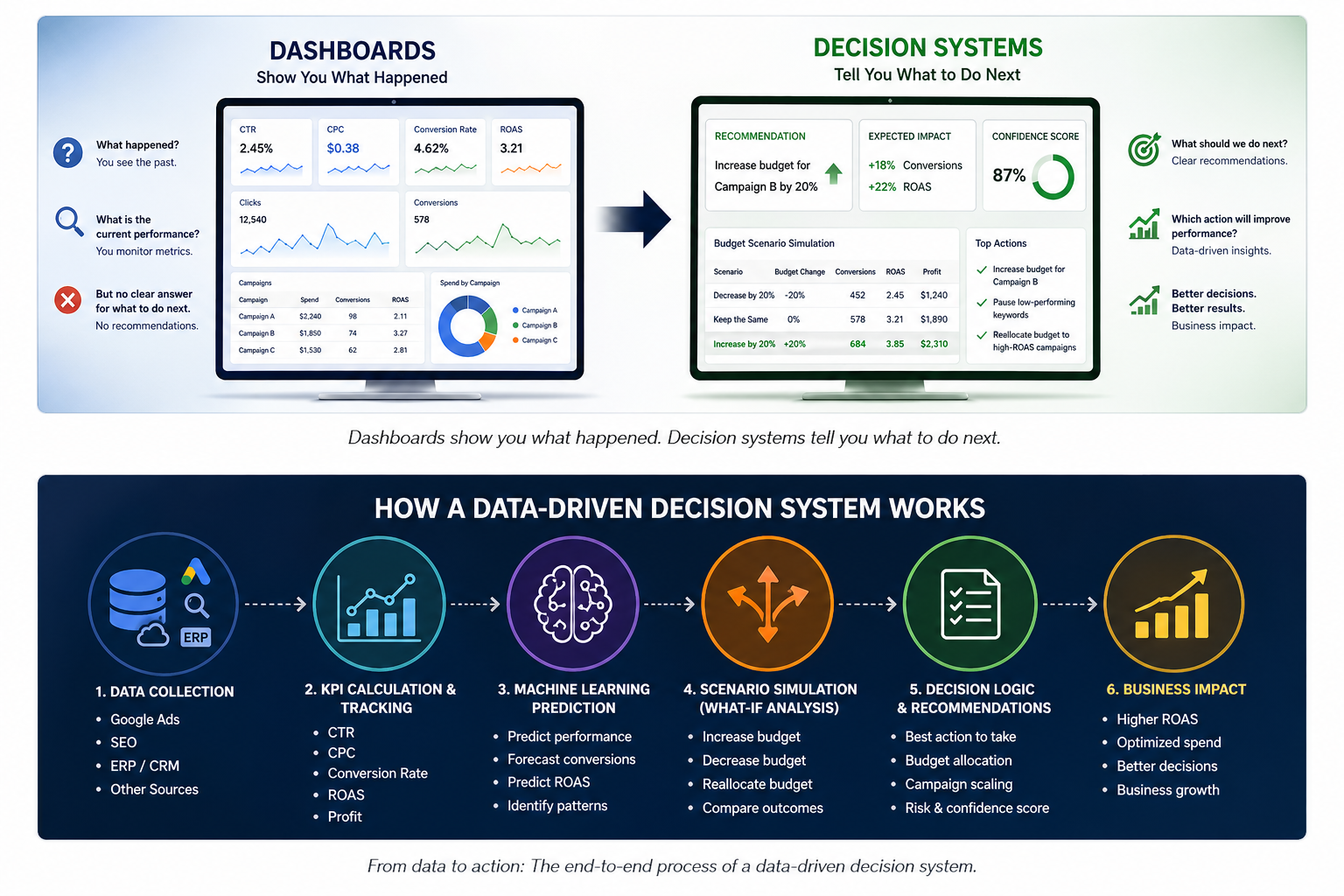
The Real Problem with Dashboards
Today, many companies invest heavily in dashboards and reporting tools. They track key performance metrics such as revenue, CTR (Click-Through Rate), conversion rate, and ROAS (Return on Ad Spend).
However, having access to data does not always lead to better decisions.
In my experience, most businesses do not struggle with collecting data. Instead, they struggle with turning data into action. This is one of the biggest gaps in modern data-driven decision making.
You can explore my full portfolio and real-world projects here: https://ozlemtonbul.com
The Problem: Data Without Action
Dashboards are powerful tools for monitoring performance and understanding what is happening in a business.
They typically answer questions like:
- What happened?
- What is the current performance?
But they usually fail to answer the most critical business questions:
- What should we do next?
- Which action will improve performance?
This creates a gap between data analytics and real business decisions.
As a result, many companies have data visibility but lack actionable insights.
Real Example: Google Ads Campaign Analysis
In one of my projects, I analyzed Google Ads campaign performance using a detailed dashboard.
The dashboard included key metrics such as:
- CTR
- CPC (Cost Per Click)
- Conversion Rate
- ROAS
All performance data was clearly visible.
However, there was one major problem:
There was no clear decision.
The system could not answer:
- Should we increase the campaign budget?
- Which campaign is worth scaling?
- What is the expected business impact of our actions?
This is where traditional business intelligence dashboards fall short.
The Solution: Decision Systems
To solve this problem, I shifted my focus from dashboards to building decision systems.
A decision system goes beyond reporting. It transforms data into actionable recommendations.
A typical AI-powered decision system includes:
- Data collection (Google Ads, SEO, ERP systems)
- KPI calculation and performance tracking
- Machine learning models for prediction
- Scenario simulation (what-if analysis)
- Decision logic layer (recommendations)
This system is part of a broader approach where I combine machine learning with decision systems. I explained the full machine learning pipeline and modeling process in detail in my previous article: [How I Built an AI-Powered Budget Optimization System Using Google Ads Data]

Real System I Built: Ads ML Budget Intelligence
To address this gap, I developed a real-world system:
Vicco Ads ML Budget Intelligence Pipeline
You can explore the full project and implementation here:
🔗 GitHub Project:
https://github.com/ozlemtonbul/ads-ml-budget-intelligence
What This System Does
- Collects Google Ads campaign data
- Calculates key KPIs (CTR, CPC, Conversion Rate, ROAS, Profit)
- Uses machine learning models (Random Forest) to predict performance
- Simulates multiple budget scenarios (increase, decrease, maintain)
- Identifies the optimal budget allocation
- Provides decision recommendations with confidence scoring
Internal Link: SEO Decision System (Organic Growth)
Decision systems are not limited to paid marketing.
I also built a system for organic growth:
SEO Organic Growth Intelligence Pipeline
This system focuses on:
- Predicting organic traffic (clicks & impressions)
- Identifying high-impact pages
- Estimating ROI of SEO actions
- Prioritizing optimization efforts based on business value
You can explore the SEO decision system here:
🔗 GitHub Project:
https://github.com/ozlemtonbul/seo-organic-growth-intelligence
This shows how decision systems can be applied across both paid (Ads) and organic (SEO) channels.
What a Decision System Does
A well-designed decision system can answer key business questions such as:
- What happens if we increase the budget by 20%?
- Which campaign generates the highest return?
- Where should we invest next for maximum growth?
This transforms analytics from:
Reporting → Data-driven decision making
Business Impact of Decision Systems
Implementing decision systems instead of relying only on dashboards creates real business value.
It helps businesses:
- Improve ROAS
- Reduce wasted ad spend
- Make faster and more confident decisions
- Scale high-performing campaigns
- Optimize both paid and organic growth
Instead of only observing data, companies start acting on data.
Conclusion
Dashboards are important for monitoring performance, but they are not enough on their own.
The real value of data analytics comes from building systems that:
- Analyze data
- Predict future outcomes
- Recommend clear actions
This is the foundation of data-driven decision systems.
When businesses move from dashboards to decision systems, they unlock real growth potential and turn data into measurable results.
If you want to see more real-world decision systems and case studies, you can explore my work here: https://ozlemtonbul.com