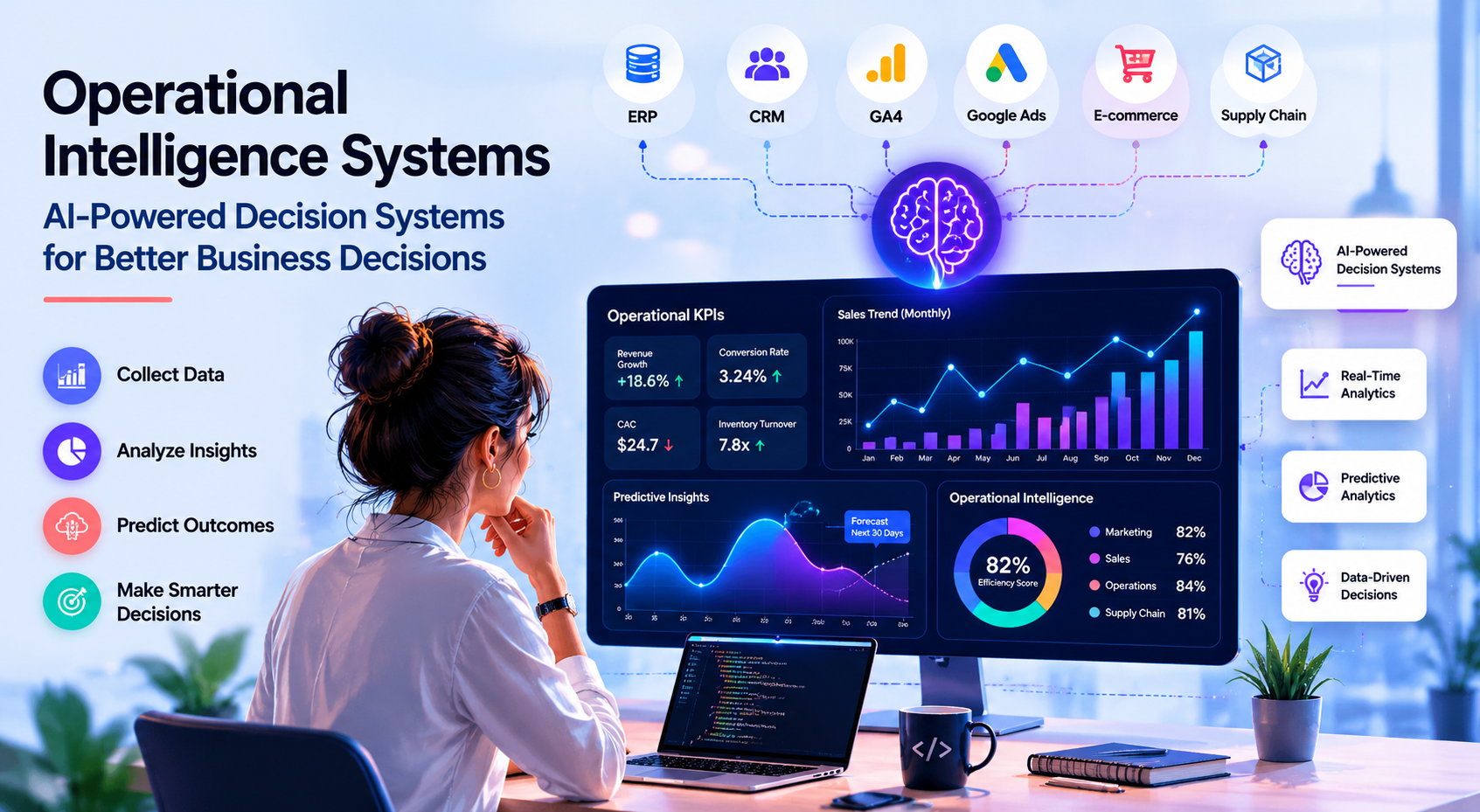
Why Data Alone Is No Longer Enough
Modern businesses generate massive amounts of operational data every day.
Companies collect information from:
- ERP systems
- CRM platforms
- Google Analytics 4
- Google Ads
- E-commerce platforms
- Supply chain systems
- Inventory management tools
However, data alone does not improve business performance.
Organizations need Operational Intelligence systems capable of transforming raw business data into actionable insights and intelligent business decisions.
This is where Business Intelligence, Predictive Analytics, and AI-Powered Decision Systems become essential.
Operational Intelligence helps businesses improve operational efficiency, optimize analytics systems, and support data-driven decision-making processes.
Understanding Operational Intelligence Systems
Operational Intelligence is the process of collecting, analyzing, monitoring, and transforming operational data into real-time or near real-time business intelligence.
Traditional analytics systems mainly focus on historical reporting.
Operational Intelligence focuses on:
- Decision-making systems
- Predictive analytics
- Operational analytics
- AI-driven insights
- Real-time business intelligence
- Data-driven operational optimization
The goal is not simply reporting performance metrics.
The goal is improving future business decisions.
Why Traditional Dashboards Are No Longer Enough
Many organizations rely heavily on dashboards and static reports.
Executives monitor KPIs.
Managers analyze reports.
Teams track operational metrics.
However, dashboards alone do not create business intelligence.
A traditional dashboard shows performance metrics.
An AI-powered decision system explains patterns, predicts future outcomes, and recommends business actions.
This is the major difference between reporting systems and intelligent analytics systems.
Modern businesses increasingly require:
- Decision Intelligence
- Predictive Analytics
- Operational Intelligence
- AI-powered analytics frameworks
instead of traditional static dashboards.
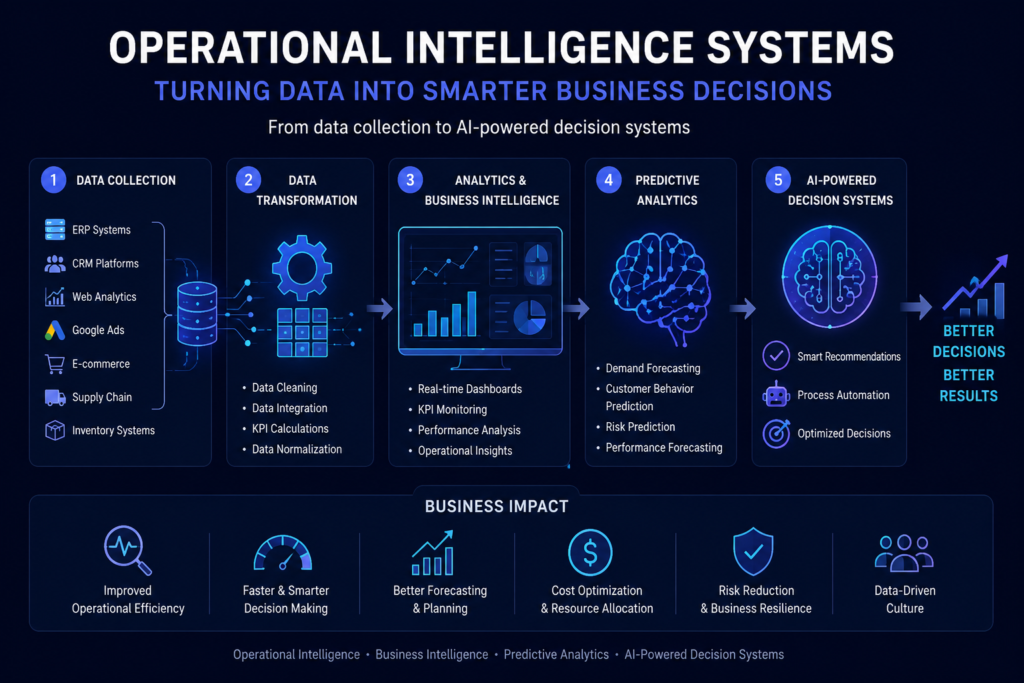
Core Components of Operational Intelligence Systems
Data Collection Layer
Operational Intelligence systems collect data from multiple business channels, including:
- ERP systems
- CRM platforms
- Google Analytics 4
- Google Ads
- Inventory systems
- Marketing platforms
- Supply chain systems
Data integration is one of the most critical components of business analytics systems.
Data Transformation Layer
Raw business data must be transformed into structured datasets.
Python, SQL, and ETL pipelines are commonly used for:
- Data cleaning
- Data normalization
- KPI calculations
- Data integration
- Operational analytics processing
Without structured datasets, analytics systems cannot generate reliable business intelligence.
Analytics Layer
Business Intelligence systems monitor critical operational KPIs such as:
- Revenue growth
- Customer acquisition cost
- Conversion rate
- Inventory turnover
- Return on advertising spend
- Operational efficiency metrics
This layer allows organizations to measure operational performance more effectively.
Predictive Analytics Layer
Predictive Analytics systems forecast future business outcomes using machine learning models and data analytics techniques.
Examples include:
- Demand forecasting
- Inventory prediction
- Customer behavior analysis
- Campaign performance forecasting
- Operational risk analysis
Predictive Analytics helps organizations move from reactive decision-making toward proactive business strategies.
AI-Powered Decision Layer
The final layer converts analytics into actionable business intelligence.
AI-Powered Decision Systems help businesses:
- Optimize operations
- Improve operational efficiency
- Detect business risks
- Improve resource allocation
- Automate repetitive decisions
- Support strategic decision-making
This is where Artificial Intelligence creates measurable business impact.
Operational Intelligence in E-Commerce Analytics
Operational Intelligence is particularly valuable for e-commerce businesses.
E-commerce platforms generate large amounts of operational and behavioral data.
Businesses can monitor:
- Product performance
- Customer behavior
- Marketing analytics
- Inventory optimization
- Supply chain analytics
- Conversion performance
By combining Predictive Analytics and Operational Intelligence, organizations can improve operational efficiency and business profitability.
The Role of AI in Operational Intelligence
Artificial Intelligence is transforming modern Business Intelligence systems.
AI-powered analytics frameworks can:
- Detect hidden operational patterns
- Predict operational risks
- Optimize marketing budgets
- Improve inventory planning
- Automate operational processes
- Improve business decision-making
The future of Operational Intelligence increasingly depends on AI-driven analytics systems.
Businesses no longer need more data.
They need intelligent decision systems capable of transforming data into operational intelligence.
Related Articles:
- AI-Powered Marketing Intelligence Systems
- Building Automated Reporting Systems with GA4 and Google Ads API
- Google Ads Budget Optimization Using Machine Learning
- E-commerce Analytics Dashboard with Python and Power BI
GitHub Projects:
https://github.com/ozlemtonbul
Portfolio Website:
https://ozlemtonbul.com
LinkedIn:
https://linkedin.com/in/özlemtonbul
The Future of AI-Powered Operational Intelligence
Operational Intelligence bridges the gap between raw data and business decisions.
Organizations that successfully combine:
- Business Intelligence
- Predictive Analytics
- AI-Powered Decision Systems
- Operational Analytics
- Data-Driven Decision Making
will gain a significant competitive advantage.
The future belongs to businesses capable of turning operational data into intelligent decisions faster than their competitors.