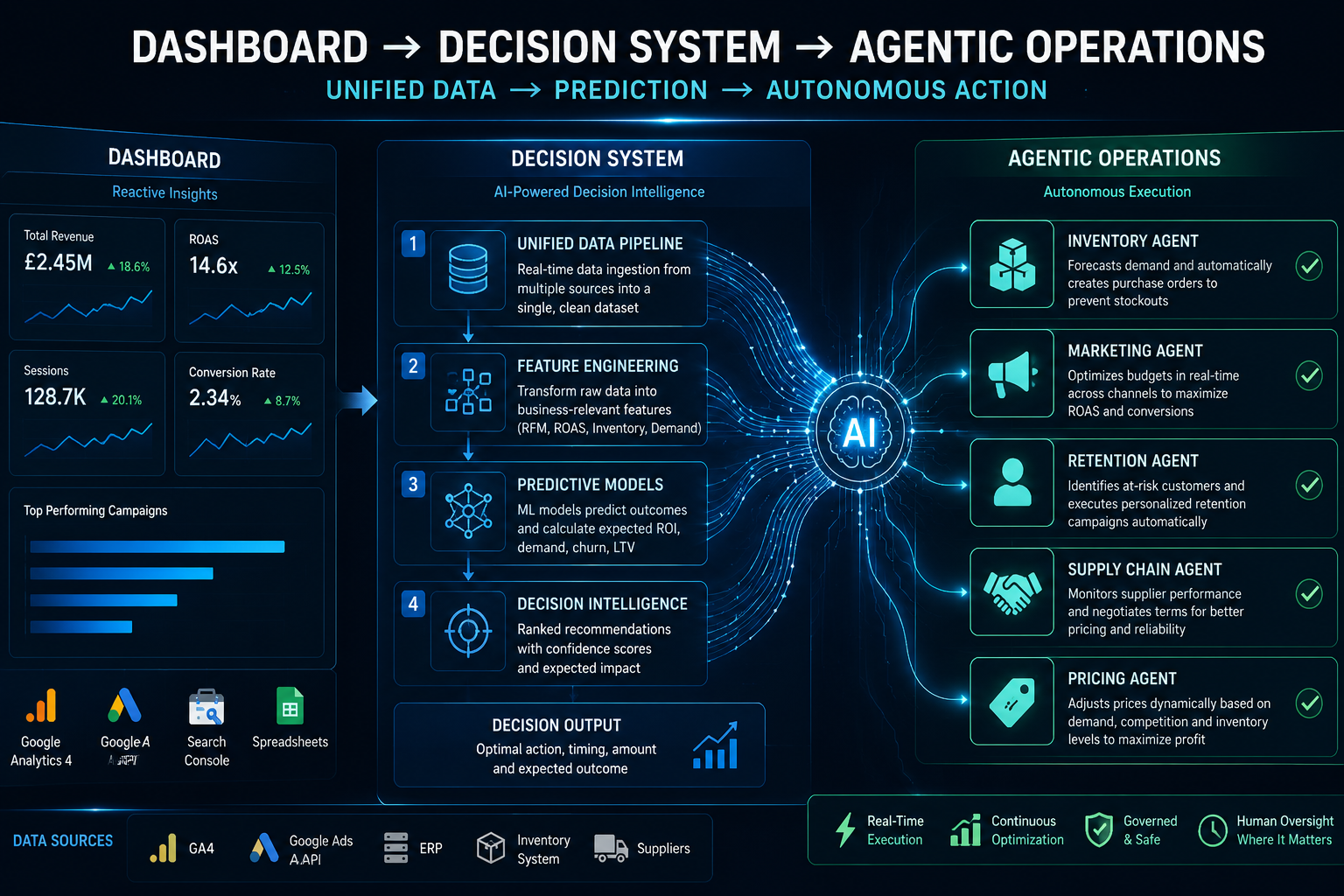
For the last few years, the most important question in e-commerce analytics has been: how do we get data closer to the decision?
In 2026, that question has a new answer and it is more ambitious than most teams expected.
Agentic AI is no longer a research concept. It is the operational direction that Amazon, Shopify, and Walmart are already building toward, and what Gartner’s 2026 technology trends confirm as one of the most strategically significant shifts for enterprise organisations. Autonomous AI agents that don’t just recommend actions but execute them across inventory, budget allocation, customer retention, and supplier negotiation without waiting for a human to review a report first.
This article explains what agentic AI actually means in an e-commerce context, how it builds on the decision systems architecture I have been developing across real production systems, and what teams need to get right before they can deploy autonomous operations effectively.
What Agentic AI Actually Means
There is a meaningful difference between an AI system that recommends and an AI system that acts.
The decision systems I have built the SEO intelligence pipeline that generated +177% organic traffic, the Google Ads ML budget system that held ROAS at 14.6x during 30% YoY revenue growth, the marketing decision intelligence pipeline that automated 40+ hours of manual analysis monthly all operate on a human-in-the-loop model. The system generates a ranked recommendation with expected ROI. A human approves or overrides.
Agentic AI removes that approval step for decisions within a defined scope.
Rather than waiting for weekly reports, businesses can adjust pricing, inventory, and marketing campaigns in real-time based on live customer engagement and market conditions. The shift from reactive to proactive commerce is happening through AI agents that handle everything from inventory management to customer negotiations. These systems don’t just respond to events they anticipate needs, execute decisions, and continuously optimize performance without human intervention.
The architecture underneath is identical to what I described in Operational Intelligence: AI-Powered Decision Systems for Better Business Decisions. What changes is the final layer the action layer which now executes autonomously rather than presenting a recommendation for human review.

The Four Layers, Revisited for Agentic Operations
The decision system architecture I apply across every project follows four layers. In an agentic context, each layer takes on additional requirements.
Layer 1 Unified data pipeline
In a standard decision system, this layer feeds a model that generates a recommendation. In an agentic system, it needs to operate in real time feeding the agent continuous signals from GA4, Google Ads API, ERP, inventory management, and supplier systems simultaneously. Latency matters more. Data quality matters more. An agent acting on stale or incomplete data makes expensive mistakes autonomously.
Layer 2 Feature engineering
The same business-relevant features apply RFM scores, ROAS trajectories, inventory days-remaining, demand signals but the feature refresh cycle compresses from weekly or daily to hourly or continuous. The model needs to learn from signals that are happening now, not signals from last week’s batch.
Layer 3 Predictive modelling
Random Forest and gradient boosting remain the most reliable choices for tabular e-commerce data. What changes is the confidence threshold required for autonomous execution. A model that produces a recommendation for human review can operate at 65% confidence. A model that autonomously executes a £10,000 budget reallocation needs a higher bar and a clear protocol for what happens when confidence falls below it.
Layer 4 Autonomous action layer
This is where agentic systems diverge from decision systems. Instead of producing “move £2,400 from Campaign A to Campaign C approve?” the agent executes the reallocation directly via the Google Ads API, logs the action with its reasoning, and flags the outcome for human review after the fact rather than before.
As AI agents gain more autonomy in commerce, trust is rapidly becoming the ultimate competitive advantage. The design of the action layer what the agent can do autonomously, what requires approval, and what gets escalated is the most critical governance decision in any agentic deployment.
What E-Commerce Teams Can Automate Right Now
Not every decision is ready for autonomous execution. The readiness depends on two factors: decision frequency and reversibility.
High-frequency, reversible decisions are the best starting point. These include:
Ad budget microadjustments. Daily or intraday reallocation of budget across campaigns based on real-time ROAS signals. The system I built for Google Ads ML budget optimization already operates close to this the next step is removing the approval gate for adjustments below a defined threshold.
Inventory reorder triggers. When demand forecasting predicts a stockout within a defined window and supplier lead time is known, the reorder can be executed automatically. Agentic AI in B2B automates tough purchasing, inventory renewal, and invoice reconciliation. These agents can connect with vendor systems, handle supply chain procedures, and negotiate prices, going beyond basic automation to proactive purchasing.
Retention campaign triggers. When a customer’s churn probability exceeds a defined threshold, the retention sequence executes automatically no weekly segmentation review required.
SEO prioritisation updates. As new Search Console data arrives, the ROI scoring model re-ranks the optimisation queue automatically, surfacing new opportunities without a monthly manual audit.
Lower-frequency, higher-stakes decisions major budget reallocations, pricing strategy changes, supplier contract negotiations remain in the human-in-the-loop model for now. The value of agentic AI is not in removing humans from all decisions. It is in reserving human judgment for the decisions that actually require it.
What Has to Be in Place First
AI agents depend on structured, consistent, and real-time data to function. If that data is incomplete or inaccessible, products may be excluded from consideration. This applies equally to operational agents an agent acting on unreliable inventory data will make confident, fast, expensive mistakes.
Before deploying any agentic capability, three things need to be solid:
1. Clean, unified data pipelines. The same foundation I described in Why Dashboards Don’t Drive Decisions GA4, Google Ads API, ERP, inventory data in a single structured dataset. An agent cannot operate on manual exports and disconnected spreadsheets.
2. Validated predictive models. Models need a track record before they act autonomously. The four-to-six week accuracy measurement period I described in Predictive Analytics vs. Reactive Analytics is the minimum before any autonomous execution is enabled.
3. Defined action boundaries. Every agentic deployment needs explicit rules: what the agent can execute autonomously, what threshold triggers human review, and what creates an automatic escalation. These are governance decisions, not technical ones and they need to be made before deployment, not after the first expensive mistake.
The Competitive Shift Already Underway
2026 is different. Advances in generative AI, real-time data processing, and agentic AI have moved the technology from assistant to decision maker. AI can now reason across complex inputs, better predict likely behaviour, and automate decisions across much more of the customer journey.
The teams that will have a structural advantage over the next two to three years are not the ones that adopt agentic AI the fastest. They are the ones that have already built the underlying decision system architecture clean pipelines, validated models, decision output layers and are now extending that architecture toward autonomous execution in a controlled, measurable way.
That is the path. Not from dashboard to autonomous agent in one step, but from dashboard to decision system to agentic operations each layer building on the one before it.
📂 GitHub — All Repositories · 🌐 Portfolio & Dashboards · 📖 Book: AI-Powered Marketing Intelligence — Amazon UK
Related: Operational Intelligence: AI-Powered Decision Systems · From Dashboards to Decision Systems · Predictive vs Reactive Analytics · Google Ads Budget Optimization Using Machine Learning