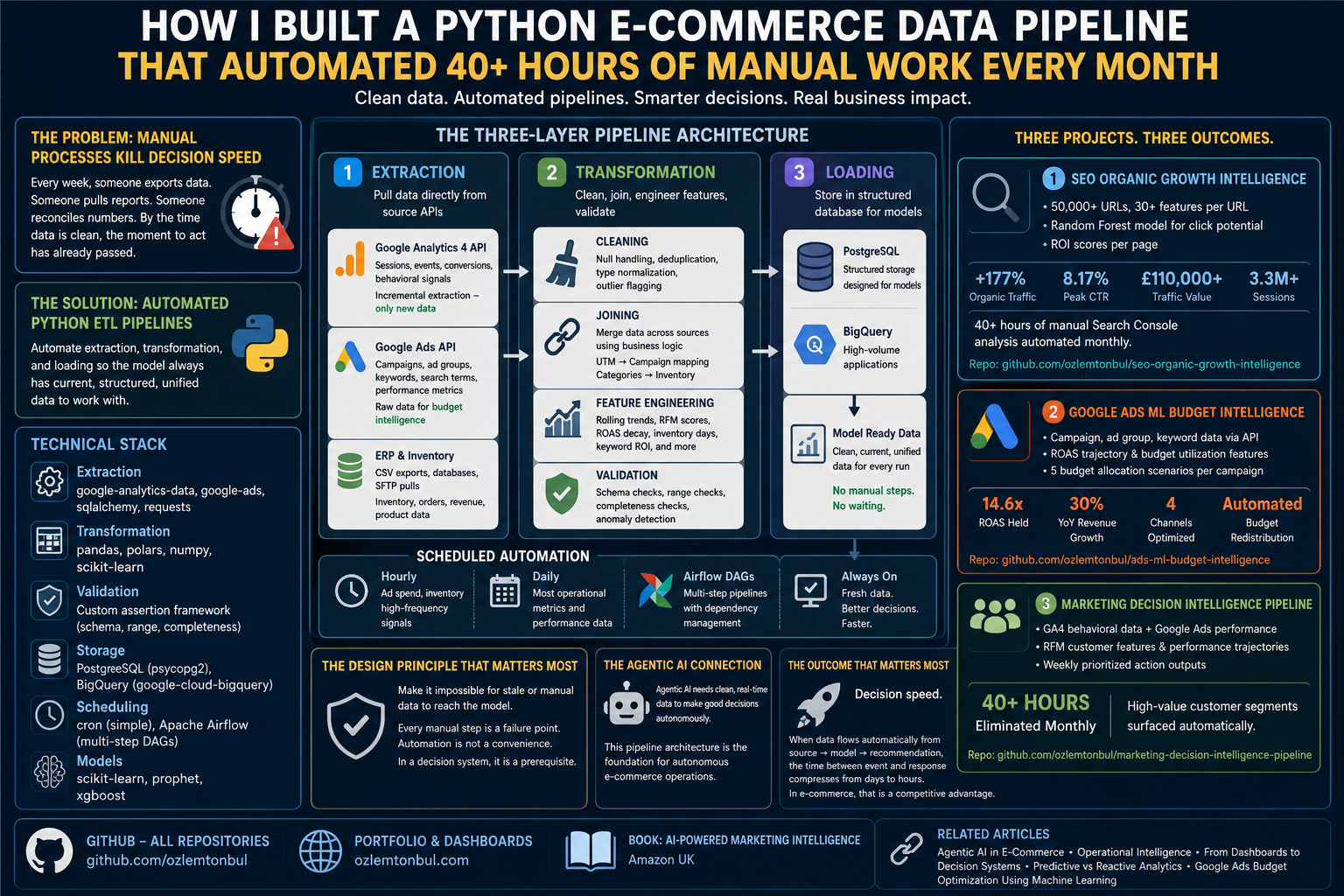
The most expensive thing in most e-commerce analytics operations is not the tools. It is the people manually moving data between them.
Every week, someone exports from GA4. Someone pulls the Google Ads report. Someone reconciles the ERP numbers with the inventory spreadsheet. Someone combines all of it into a format the model can actually use. By the time the data is clean enough to act on, the moment to act has often already passed.
This article documents the Python data pipeline architecture I built to eliminate that process and the measurable business outcomes it produced across three e-commerce projects.
Why Manual Data Processes Kill Decision Speed
The gap between data and decision is almost always a pipeline problem before it is a model problem.
As I explored in Why Dashboards Don’t Drive Decisions, the structural failure in most e-commerce analytics setups is not bad data or bad analysis. It is bad data infrastructure disconnected sources, manual exports, and refresh cycles measured in days rather than hours.
A predictive model running on week-old data is not a decision system. It is a delayed report with extra steps.
The Python ETL pipelines I build solve this at the source automating extraction, transformation, and loading so that the model always has current, structured, unified data to work with.
The Three-Layer Pipeline Architecture
Every e-commerce data pipeline I build follows the same three-layer structure, regardless of the specific use case.
Layer 1 — Extraction
Data is pulled directly from source APIs rather than exported manually. The three primary sources across all three projects were:
Google Analytics 4 API session data, event data, conversion paths, and behavioral signals at page and session level. Python’s google-analytics-data library handles authentication and query construction. Incremental extraction pulling only new data since the last run keeps the pipeline efficient at scale.
Google Ads API — campaign, ad group, keyword, and search term performance. The google-ads Python library provides access to all performance metrics. This is where budget intelligence begins: raw impression share, ROAS, and spend data feed directly into the optimization model documented in Google Ads Budget Optimization Using Machine Learning.
ERP and inventory exports structured CSV or database connections depending on the client’s stack. Where APIs are not available, scheduled SFTP pulls or direct database connections via SQLAlchemy replace manual exports entirely.
The extraction layer runs on a scheduled basis daily for most operational metrics, hourly for high-frequency signals like ad spend and inventory levels.
Layer 2 — Transformation
Raw extracted data is rarely model-ready. The transformation layer handles four categories of work:
Cleaning null handling, deduplication, type normalization, and outlier flagging. pandas handles most of this. For large datasets the SEO pipeline processing 50,000+ URLs required significant memory management polars offers substantially better performance.
Joining merging data across sources into a unified dataset. Session data joined to ad spend data joined to revenue data joined to inventory data. The join logic encodes business knowledge: which UTM parameters map to which campaigns, which product categories map to which inventory buckets.
Feature engineering computing the variables the model actually learns from. Rolling 7-day and 30-day revenue trends. RFM scores per customer segment. ROAS decay signals per campaign. Inventory days-remaining per SKU. Keyword ROI estimates per URL. This is where domain knowledge determines model quality a pipeline that produces the right features from the right data makes even simple models highly effective.
Validation automated checks that flag anomalies before they reach the model. If GA4 sessions drop 80% overnight, the pipeline flags it rather than feeding the model corrupted data. Silent data quality failures are more dangerous than visible pipeline errors.
Layer 3 — Loading
Transformed data is written to a structured storage layer PostgreSQL for most projects, BigQuery for higher-volume applications. The storage schema is designed around the model’s query patterns, not around the source data’s original structure.
From the storage layer, the model reads clean, current, unified data on every run. No manual steps. No waiting for someone to finish the weekly export.
What This Enabled: Three Projects, Three Outcomes
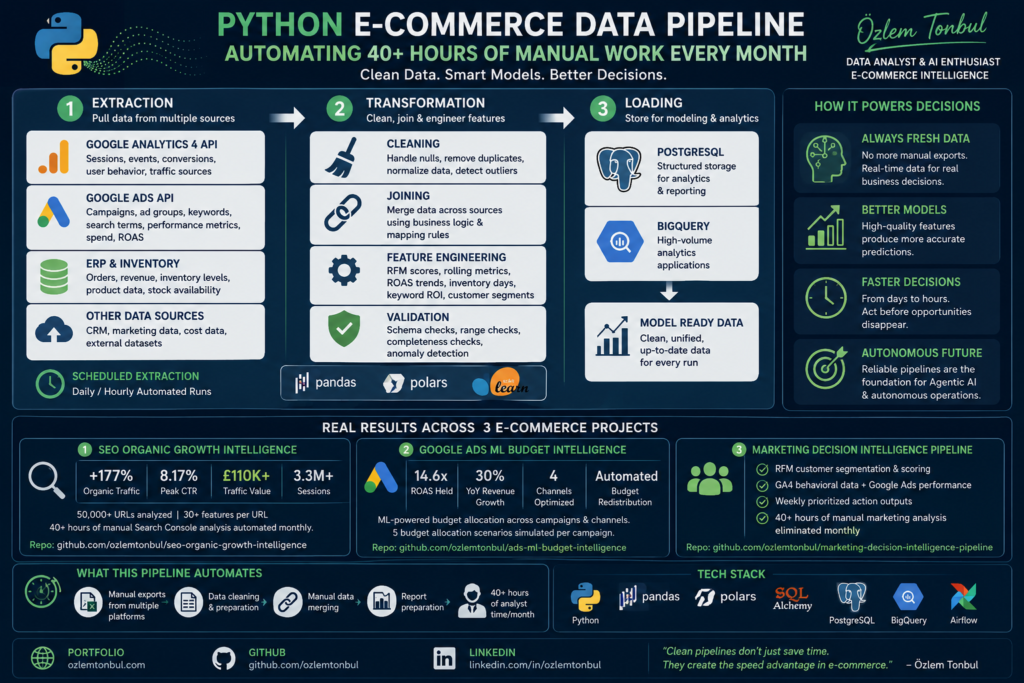
The same pipeline architecture, applied to three different e-commerce decision problems, produced three distinct sets of outcomes.
SEO Organic Growth Intelligence
50,000+ URLs extracted from Search Console API, transformed with 30+ engineered features per URL, loaded into a structured dataset that fed a Random Forest model forecasting click potential and computing ROI scores per page.
Result: +177% organic traffic, 8.17% peak CTR, £110,000+ traffic value, 3.3M+ sessions. 40+ hours of manual Search Console analysis automated monthly.
Repository: github.com/ozlemtonbul/seo-organic-growth-intelligence
Google Ads ML Budget Intelligence
Campaign, ad group, and keyword data extracted via Google Ads API, transformed with ROAS trajectory and budget utilization features, loaded into the model that simulated five budget allocation scenarios per campaign.
Result: ROAS held at 14.6x throughout 30% YoY revenue growth. Budget redistribution automated across four channels.
Repository: github.com/ozlemtonbul/ads-ml-budget-intelligence
Marketing Decision Intelligence Pipeline
GA4 behavioral data and Google Ads performance data extracted via APIs, transformed with RFM customer features and campaign performance trajectories, loaded into segmentation and scoring models producing weekly prioritised action outputs.
Result: 40+ hours of manual marketing analysis eliminated monthly. High-value customer segments surfaced automatically.
Repository: github.com/ozlemtonbul/marketing-decision-intelligence-pipeline
The Technical Stack
Across all three projects, the core Python stack was consistent:
- Extraction:
google-analytics-data,google-ads,sqlalchemy,requests - Transformation:
pandas,polars(large datasets),numpy,scikit-learn(feature engineering utilities) - Validation: custom assertion framework built on
pandas— schema checks, range checks, completeness checks - Storage:
PostgreSQLviapsycopg2,BigQueryviagoogle-cloud-bigquery - Scheduling:
cronfor simple pipelines,Apache Airflowfor multi-step DAGs with dependency management - Models:
scikit-learn(Random Forest, Gradient Boosting),prophet(time series),xgboost
No enterprise data platform required. The entire stack runs on a standard cloud VM or local server with a reliable internet connection.
The Design Principle That Matters Most
Technical choices are secondary to one architectural decision: the pipeline should make it impossible for stale or manual data to reach the model.
Every manual step in a data pipeline is a failure point a place where the process stops when the person responsible is sick, on holiday, or just busy. Automation is not a convenience. In a decision system context, it is a prerequisite.
As I detailed in Operational Intelligence: AI-Powered Decision Systems, the quality of the decision output layer depends entirely on the quality of the data flowing into it. Clean pipelines are not the interesting part of building decision systems. They are the part that determines whether everything else works.
The Agentic AI Connection
As I explored in Agentic AI in E-Commerce: From Decision Systems to Autonomous Operations, the next phase of e-commerce analytics is autonomous execution agents that act on model outputs without human approval for each decision.
The pipeline architecture described in this article is the prerequisite for that transition. An agentic system acting on stale, manual, or disconnected data makes expensive mistakes autonomously. Clean, automated, real-time data infrastructure is not just the foundation for current decision systems — it is the entry requirement for the next generation of autonomous e-commerce operations.
Final Thoughts
The automation numbers across the three projects above 40+ hours per month eliminated in each case are not the most important outcome of building reliable Python data pipelines. The most important outcome is decision speed.
When data moves automatically from source to model to recommendation without human intervention, the time between a business event and an appropriate business response compresses from days to hours. In e-commerce, that compression is a structural competitive advantage.
📂 GitHub — All Repositories
🌐 Portfolio & Interactive Dashboards
📖 Book: AI-Powered Marketing Intelligence — Amazon UK
Related: Agentic AI in E-Commerce · Operational Intelligence · From Dashboards to Decision Systems · Predictive vs Reactive Analytics · Google Ads Budget Optimization Using Machine Learning